

AI May Replace Millions of Jobs, But These Small Business Careers are Safer Than You Think
A new experiment by AI researcher Andrej Karpathy is sparking a major conversation about the future of work.
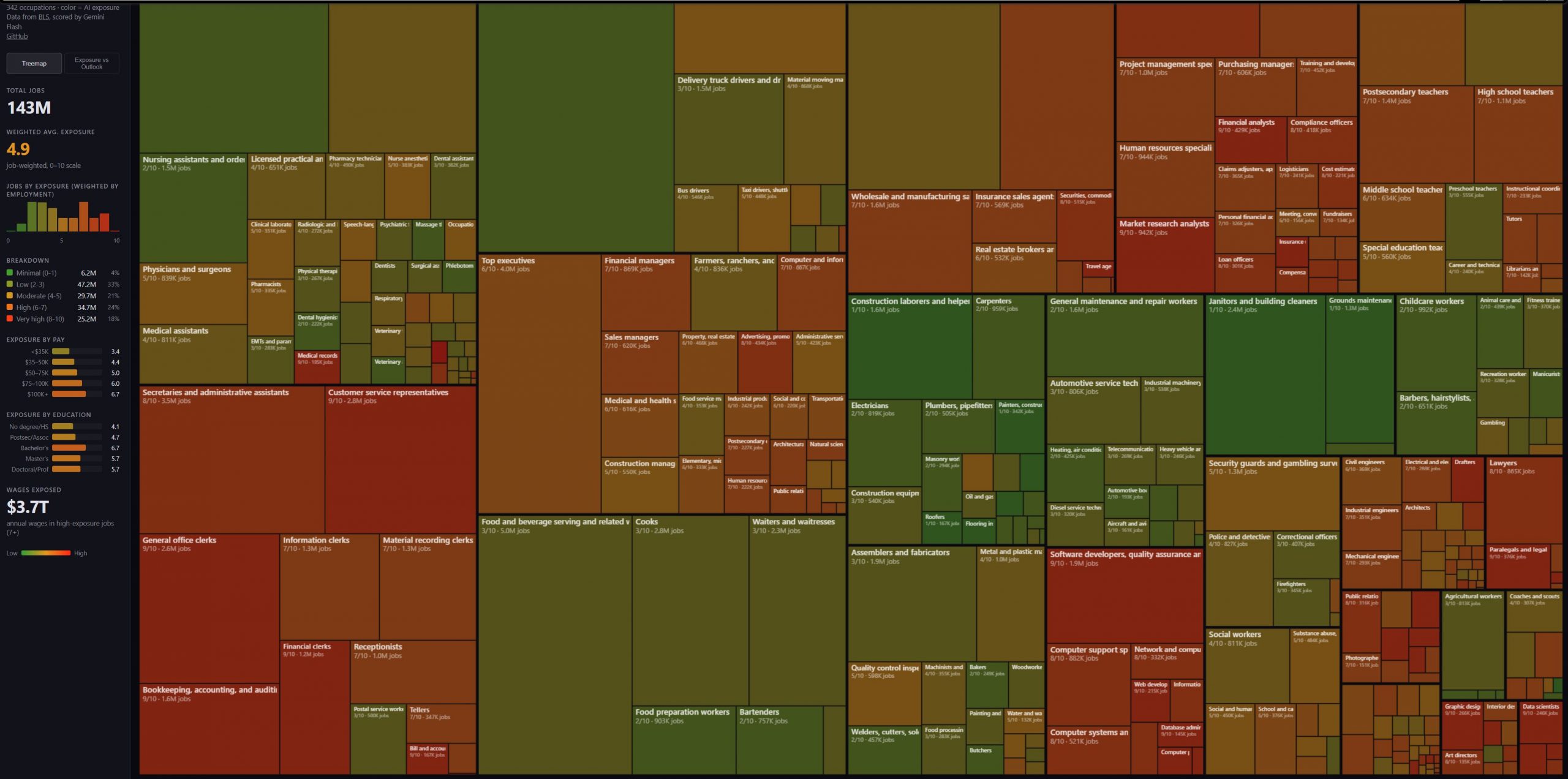
Karpathy recently built a tool that evaluates how vulnerable different professions are to artificial intelligence. Using data from the U.S. government, he analyzed 342 occupations and scored each one from 0 to 10 based on AI exposure.
The rule was simple:
If your job can be done from a home office on a laptop, AI can probably do it too.
The results surprised a lot of people. (1 being not good for AI, 9 AI can do it)
- Roofers: 1
- Plumbers: 2
- Firefighters: 2
- Writers and editors: 8
- Data analysts: 9
- Software developers: 9
Millions of workers are now looking at their profession and wondering where they fall on that scale.
The Irony of the “Learn to Code” Era
For years, the dominant advice given to students and career changers was simple: learn to code.
Programming was considered one of the safest and most lucrative career paths in the modern economy.
But now many of the jobs once considered “future-proof” are some of the most exposed to automation. Large language models can already write software, generate marketing copy, analyze data, and automate administrative work.
The very careers built around working on a computer may now be the easiest for AI to replicate.
A Different Perspective From Silicon Valley
Not everyone believes AI will make human work obsolete.
When Karpathy’s project began circulating online,
Elon Musk commented that AI could eventually make jobs optional and create a form of universal high income.
Meanwhile, former Uber CEO Travis Kalanick offered a different interpretation.
In a highly automated future, he argued, human labor could actually become more valuable, especially in fields where physical skill and real-world problem solving matter.
His example was plumbers.
In a world where software and digital tasks are automated, someone who can diagnose a pipe problem, crawl through a crawlspace, and fix a real-world system could become incredibly valuable.
Kalanick compared these professionals to professional athletes in the economy.
In other words, plumbers might become the LeBron James of the automated age.
The Jobs AI Struggles With
Artificial intelligence excels at digital work. It can process information, generate text, analyze patterns, and automate tasks that happen entirely on a screen.
But there is one major limitation.
AI cannot physically interact with the real world.
That means jobs that require hands, tools, and physical presence remain extremely difficult to automate.
Many of these professions are run by small businesses and independent tradespeople.
Examples include:
- Carpenters
- Electricians
- Plumbers and pipefitters
- Painters
- Masonry workers
- Roofers
- Flooring installers and tile setters
- Sheet metal workers
- Drywall installers and tapers
- Ironworkers
- Insulation workers
- Glaziers
- Solar panel installers
- Elevator and escalator technicians
- Boilermakers
- HVAC technicians
- Telecommunications technicians
- Heavy equipment mechanics
- Aircraft and avionics technicians
- Small engine mechanics
- Automotive body repair specialists
- Power-line installers and repairers
These jobs require physical skill, field experience, and real-time problem solving. AI might assist with diagnostics or planning, but it cannot climb a ladder, repair a machine, or wire a building.
Skilled Trades Are Quietly Becoming Premium Careers
For years, many schools pushed students toward white-collar careers while trades were overlooked.
That trend is starting to reverse.
Trades now offer several advantages in the AI economy:
- High demand
- Limited automation risk
- Opportunities for entrepreneurship
- Strong local markets
- Essential services that cannot be outsourced
A skilled HVAC technician, electrician, or plumber can build a business that serves thousands of customers in a region.
And unlike digital work, those services cannot simply be moved overseas or automated by software.
Human Services Are Also Hard to Replace
Jobs that involve human trust, empathy, and care also remain resistant to automation.
Examples include:
- Childcare workers
- Mental health counselors
- Marriage and family therapists
- Community health workers
- Home health aides
- Fitness trainers
- Hairstylists and barbers
- Skincare specialists
- Funeral service professionals
These professions depend on human relationships, emotional intelligence, and real-world interaction.
AI may assist with scheduling, documentation, or research, but the core work still requires people.
Creative and Craft Professions Still Matter
There are also many specialized crafts and artistic professions that remain difficult for AI to replicate physically.
These include:
- Floral designers
- Bakers
- Butchers
- Woodworkers
- Welders
- Jewelers
- Machinists and tool-and-die makers
- Fabricators
- Food processing technicians
- Painting and coating workers
Many of these jobs combine craftsmanship, customization, and hands-on production.
Even as AI improves, the ability to create physical products and solve real-world problems remains valuable.
The Best Career Advice for the AI Era
The conversation about AI and jobs is only beginning. Some industries will change dramatically, while others may barely notice the shift.
But one trend is becoming increasingly clear.
The safest careers may not be the ones that require the most screen time.
Instead, they may be the ones that require real-world expertise, physical skill, and human interaction.
If a job can be done entirely from a laptop connected to the internet, AI will probably compete with it.
But if it requires tools, hands, movement, and experience, it will remain difficult to automate.
In 2026, the smartest career advice might be surprisingly simple:
Learn something a robot can’t do.
Own or starting a small business? A professional website can help more customers find and trust your company.
Call 312-380-5745 or Contact John Schuster at Company Chicago Inc. online to get started.